2026 Featured Exhibit
What does it mean to remember something? To commemorate it? Is it the same as celebrating? What does what and how we choose to remember say about us as Americans? New Yorkers? Fulton Countians?
As the country prepared to celebrate its Bicentennial in the 1970s, Americans were grappling with major changes in politics, society, and culture. The US Senate approved the Equal Rights Amendment in March 1972 (though it was not ratified by the requisite number of states until 2020). The Supreme Court gave its landmark ruling in January 1973 on Roe v. Wade, which protected women’s Constitutional right to bodily autonomy. Dealing with the fallout of the Watergate Scandal and facing impeachment, President Richard Nixon resigned on August 9, 1974.
On the world stage, the country was embroiled in an increasingly unpopular war in Vietnam. The first to be televised, the “Living Room War” brought citizens face to face with the horrors of the My Lai Massacre, napalm, Agent Orange, and a mounting death toll of both soldiers and civilians. The unorganized and chaotic evacuation after the Fall of Saigon on April 30, 1975 resulted in the abandonment of Vietnamese allies and effectively ended the war.
In the face of all of this — war, increasing distrust of governmental authority, and major social shifts — Americans were thinking about how to celebrate the country’s 200th birthday. President Gerald Ford was desperate to find some kind of common thread that would unite the country. Historian David Ryan wrote that Ford “emphasized renewal and rebirth based on a restoration of traditional values and a nostalgic and exclusive reading of the American past.”
What has changed in fifty years? Mark Twain famously quipped that “history doesn’t repeat itself, but it often rhymes.” Roe v. Wade was overturned by the Supreme Court in June 2022. President Donald Trump, serving his second non-consecutive term, has brought America into two unpopular conflicts, both of which have resulted in growing civilian casualties. The Trump administration’s efforts at censoring history has come not only through the call to ignore diversity, equity, and inclusion but also the removal and alteration of exhibits at National Park sites that mention topics like slavery, violence against Native Americans, and climate change.
Half a century later, we are still embroiled in a world of violence and inequity and an America that seems more divided than ever. Like the Ford administration, the Trump administration is eager to guide the messaging commemorating our country’s founding.
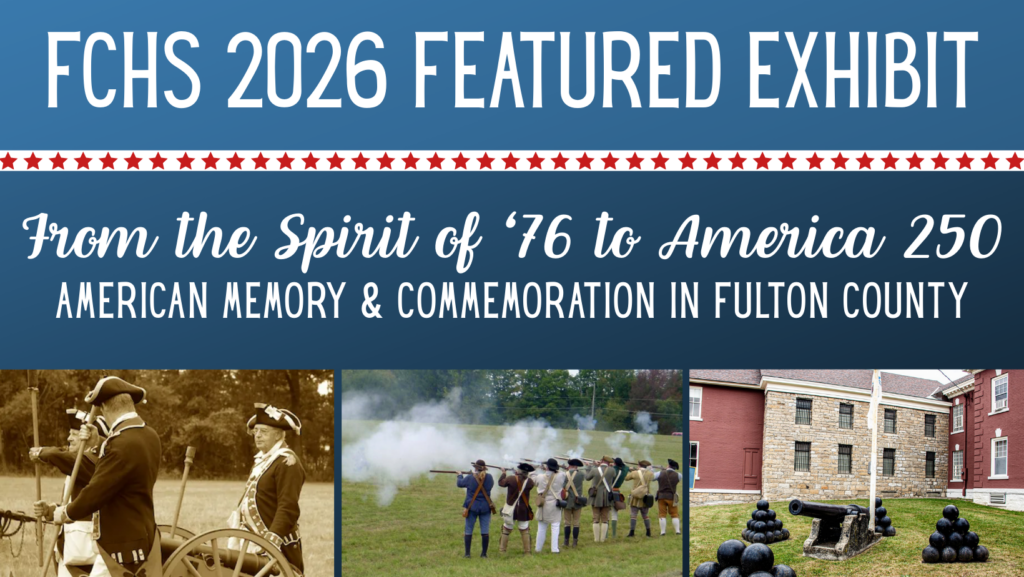
This exhibit explores the ways Fulton County commemorated the founding of America. What did our community deem important in 1976? How did we reconcile the reality of the world with the celebratory nature promoted as part of the Bicentennial? How is it different from how we commemorate our founding history today? Through newspaper articles, photos, oral histories, and other ephemera and objects, we’ll take a look at how historical memory has shaped our community through the lens of America’s birthday, from 1776 to 2026.
This exhibit will be open from May 15th through December 2026.
Permanent Displays
The Museum consists of six exhibit spaces dedicated to particular areas of Fulton County history, including:
- Sports
- Leather and Tanning
- Military
- Public Service
- Railroad History
- Native American
- Weaving and Spinning
- Technology
- Farming and Tools
- Businesses
- Victorian
- School